Saving Special Places • Building Better Communities
Join Us in Opposing Amendment 3
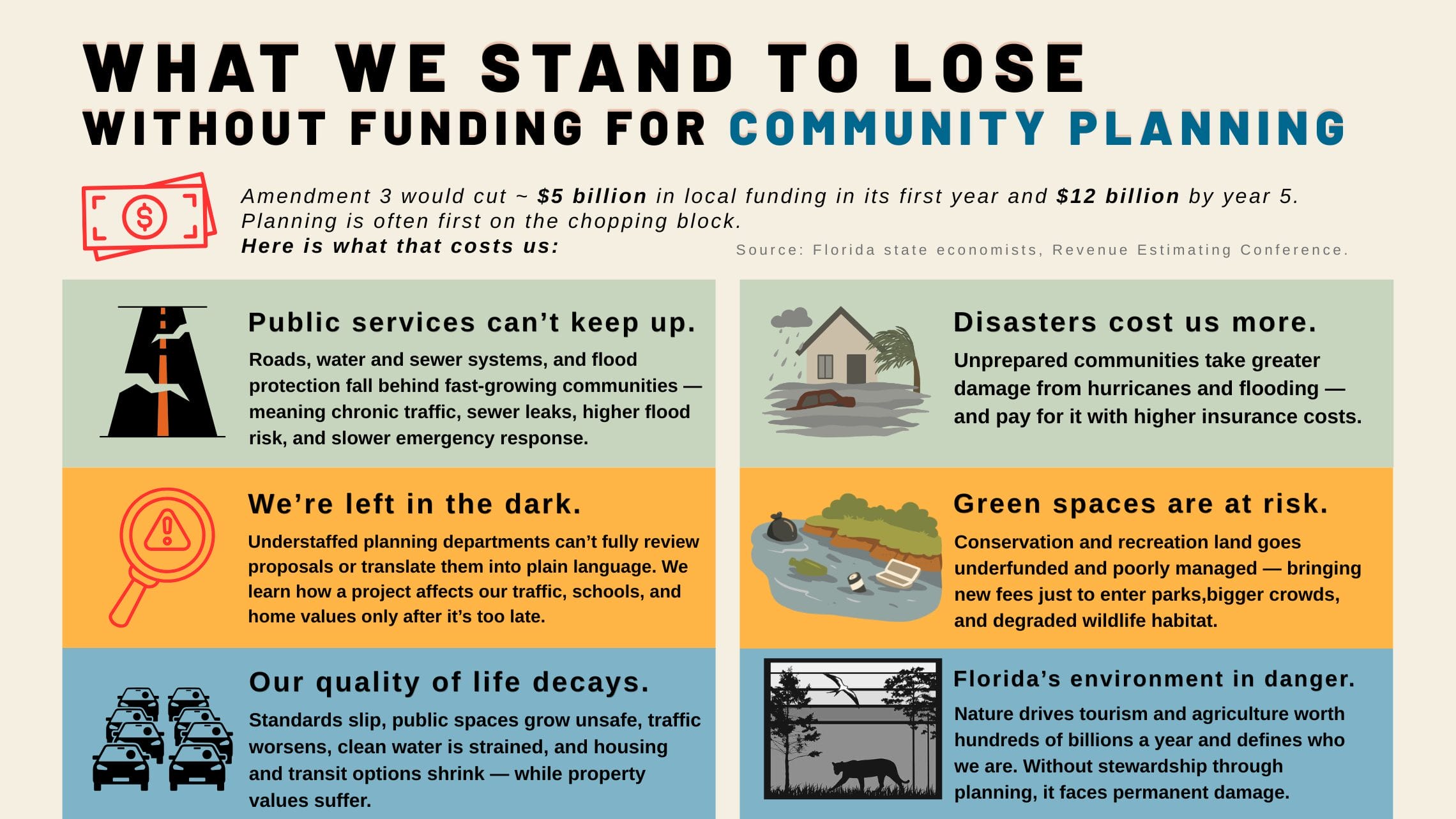
Amendment 3 promises property tax relief, but state economists project it would cut local funding by roughly $5 billion in year one and $12 billion by year five — money that pays for police and fire protection, road repairs, parks, libraries, water infrastructure, affordable housing, and conservation.
1000 Friends of Florida opposes Amendment 3 because the modest savings for some homeowners would be outweighed by the lasting harm to the services and quality of life that make Florida home.
Background
During a two-day special session in June 2026, called by the governor with only a few days’ notice, Florida lawmakers voted to place a property tax measure known as Amendment 3 on the November 2026 ballot. If approved by voters, the amendment would raise the homestead property tax exemption from $50,000 to $150,000 in 2027 and to $250,000 in 2028, with the exemption continuing to increase each year based on inflation. It would also cut in half the amount that property tax revenue from other properties could increase annually.
State economists estimate the change would reduce local government property tax revenue by approximately $5 billion in its first year and $12 billion by its fifth. Property taxes are the primary local source of funding for roads, public transportation, police and fire protection, libraries, parks, and many other services Floridians use every day. The effects would not be felt equally across the state: rural communities with fewer financial resources, and communities where most residents own homesteaded properties, could be hit especially hard.
Floridians choose to live, work, and build businesses here for many reasons — relatively low taxes, reliable public services, and access to the natural resources that make the state special. Protecting that quality of life depends on balancing all three, which relies on thoughtful planning by local communities with meaningful public participation. It is against this backdrop that 1000 Friends of Florida has concluded that the uneven and uncertain benefits from the tax cuts promised by Amendment 3 would be outweighed by the damage they would do to Florida’s communities.
Homestead: Your permanent, primary residence in Florida, the home you actually live in, not a rental, vacation, or investment property.
Homestead property tax exemption: A break that lowers the taxable value of your primary home, so you pay property tax on less than the home is worth. For example, with today’s $50,000 exemption, a $300,000 home is taxed on $250,000 of its value.
Non-homesteaded property: Everything that isn’t someone’s primary residence (rental homes, commercial buildings, second homes, and vacant land). If homestead revenue drops, taxes and fees on these properties could go up to make up the difference.
Property tax revenue: The money local governments collect from property taxes. It’s the primary local funding source for roads, police and fire protection, libraries, parks, water systems, and other everyday services.
Water management districts: Florida’s five regional agencies responsible for flood control, water supply, water-quality protection, and Everglades restoration, funded in part by local property taxes.
Taxation and Budget Reform Commission: A state commission created by Florida’s Constitution to review the tax system, scheduled to meet in 2027. This is the existing process for tax reform that Amendment 3 would bypass.
What your county stands to lose
Florida's counties rely on property taxes to pay for road repairs, public safety, libraries, parks and other local services. This map shows what percentage of that revenue each county is projected to lose if Amendment 3 passes and the homestead exemption climbs toward $250,000 — darker means deeper cuts. Switch years to watch the losses grow, and hover any county for its projected loss. Figures are estimated percentage reductions in each county's total property tax revenue, not dollar amounts or individual tax bills.
Hover over any county — or tap on a touchscreen — to see its projected revenue loss.
Source: Florida Association of Counties, County Property Tax Report (2025), fiscal-impact projections for Amendment 3. Estimated percentage reduction in total county property tax revenue by fiscal year — not dollar amounts.
What your city stands to lose
Florida's cities also rely on the same property tax base to pay for local services. Each dot is a city — the larger the circle, the larger the city's population — shaded by the projected percentage reduction in its property tax revenue by fiscal year 2028–29, when the homestead exemption reaches $250,000. Darker means a deeper cut. Figures are estimated reductions in each city's revenue, not a change to any individual tax bill.
Hover over any city — or tap on a touchscreen — to see its name and projected cut.
Based on projected reductions in taxable property value under the $250,000 homestead exemption; assumes current municipal tax rates (millage) remain unchanged.
Jacksonville is not shown separately; as a consolidated city-county government its impact is reflected in Duval County on the county map above.
Source: Florida League of Cities, 2025 City Impact Data ($250,000 Homestead Tax Exemption), 2026 — based on Florida Department of Revenue 2025 real and tangible personal property tax rolls. City population from University of Florida BEBR 2025 estimates; city locations via the Florida Geographic Information Office.
Participate
Accountability


Newsletters

Annual Reports
Special Reports